
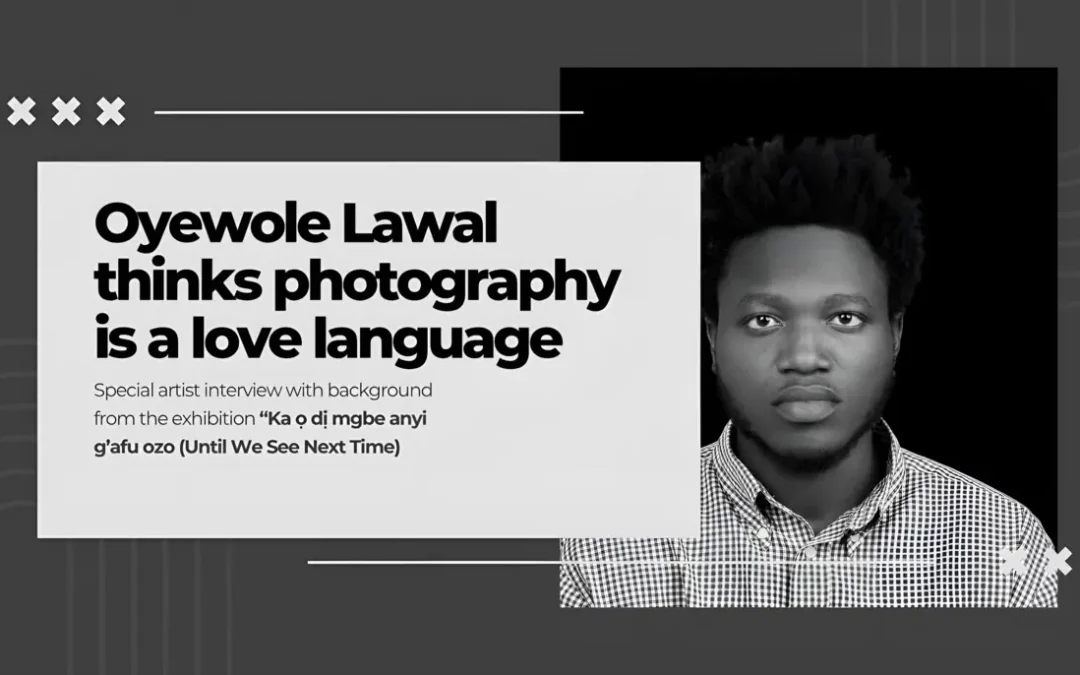
In West Africa, grief is social as much as it is personal. In this discussion, visual artist Oyewole Lawal and writer Izehi Amadasu talk about what it means to grieve, first as an individual and secondly as an individual within normative social institutions. They talk about absence, a family’s role in remembering, and the responsibilities of an artist.
Izehi: I noticed you studied sociology at the University of Lagos. How has studying sociology influenced the way you approach your art?
Oyewole: Studying Sociology at the University of Lagos fundamentally changed the way I see the world. While I was in school, I was furious about many things: social norms, class ideology, the ways certain theories are treated as universal despite being rooted in Western experiences, and the ways people can become trapped by systems they inherit without questioning them. As Africans, I think so much of who we are has been shaped and redefined by colonial histories. Sociology gave me a language for thinking about those influences, but art gave me a way to express what I was feeling.
I believe my role as an artist and a sociologist is to help people locate themselves: to think about where they stand now, where they have been, and why we define certain things in the ways that we do.
Izehi: You describe this project (exhibition) as beginning with absence: you never met your grandfather, yet you’ve spent time trying to understand the person he was. What first made you want to search for him through your art?
Oyewole: In a strange way, he met me, but I never really got the chance to meet him. I was only two years and some months old when he died, so I have no memory of him.
There is also something very particular about the circumstances surrounding his death. My baby sister was born on the same day he was laid to rest. My mother has often told me that there are many things about me that remind her of him. Combined with the dynamics of my family, that has always made me wonder what it would have been like to know him. That curiosity became a kind of loop—of searching, imagining and, in some ways, grieving someone I never consciously knew.
My art became an escape route into that absence. It gave me permission to imagine that I knew him, or at least to build some kind of relationship with him through what remained.
Izehi: Your grandfather exists in this project through stories told by your family. Do you feel like you’re discovering his memory, or are you also creating a version of him for yourself?
Oyewole: I think I’m doing both.
Every story I hear gives me another fragment of him, but those fragments are never completely objective. Everyone remembers differently. One person remembers his character, another remembers an event, while someone else remembers the impact of his absence. As those memories come together, I begin to see a person, but I also realise that the person I am seeing is partly being created through my own imagination. Because I never truly knew him, there is no way for me to completely recover who he was. I have to work with what remains and accept the gaps. So, in a way, I am discovering his memory while also creating a version of him that I can have a relationship with. I don’t think that makes the version false. Memory itself is always being reconstructed. This project is honest about that process.
“We talk about the person who died, but sometimes we don’t talk about what their absence does to the people who remain. Photography can interrupt that numbness and ask us to look again.”
Izehi: One of the most striking parts of the project is your attempt to bring your face and your grandfather’s imagined face together through mirrors. What does it mean to see yourself in someone you never actually saw?
Oyewole: My grandfather and I don’t necessarily look alike, but the mirror became important because it allowed two different realities to exist together. My face is real and present, while his face is imagined. The reflection becomes a space where the two of us can almost meet, even though we are separated by time and death.
There is something unsettling about trying to recognise yourself in someone you never really knew. You begin to wonder what you might have inherited beyond physical features: gestures, expressions, temperament, fears, or even ways of seeing the world. I cannot know which parts of me came from him, but the possibility itself is powerful.
Izehi: As an environmental photojournalist, you often bring attention to things people might otherwise ignore. This exhibition is also about breaking the silence around difficult experiences like grief and mental health. Do you think artists have a responsibility to make us look at the things we might rather not see?
I think artists have the ability to create space for things that are difficult to talk about, but I don’t necessarily believe every artist has a responsibility to address uncomfortable subjects. For me, however, that has become an important part of why I make work.
In my environmental photography, I am often drawn to things that have become normalised: waste on a beach, polluted water, or people working under difficult conditions. Because we see these things repeatedly, we can become numb to them.
This project made me realise that the same thing can happen with grief and mental health. There can be a tendency to keep certain experiences private, especially within families. We talk about the person who died, but sometimes we don’t talk about what their absence does to the people who remain. Photography can interrupt that numbness and ask us to look again.
Izehi: When you’re not photographing people, places, or social issues, what do you find yourself naturally photographing just because you find it beautiful or interesting?
Oyewole: I actually photograph people a lot, especially those I am close to and those who are part of my everyday life: family, lovers, intimate friends and acquaintances. For me, photography can be a love language. Photographing someone is sometimes my way of saying, I was here with you when you were this version of yourself, and I want to remember that we existed together.
The camera is very intimate to me. When I’m not in the field or working on a project, photography becomes quieter. I can simply be with people and observe them without the pressure of having to explain anything.
Izehi: The title of this exhibition is Ka ọ dị mgbe anyi g’afu ozo (Until We See Next Time). What does “Until we see next time” mean to you—not just as the title of an exhibition, but as a way of thinking about grief, memory, and hope?
Oyewole: The title exists inside a question I cannot answer: what does death actually end? For me, “Until We See Next Time” is an attempt to fill the void with hope. Sometimes I am scared by the thought of death. I wonder: what if we really do not meet again? What if death is simply a dark space and nothing comes after it? But then there is also hope—the possibility that perhaps we meet again somewhere else, in paradise, or in another form we cannot yet understand.
The phrase also carries uncertainty. I don’t know what “next time” means. It could mean memory, dreams, stories or photographs. It could mean that someone continues to exist through the people who remember them. Or perhaps it means something beyond what I can understand. So “Until We See Next Time” is therefore not a declaration that I know we will meet again. It is an act of faith in the possibility that absence may not be the final form of a relationship.
Artists responses have been edited for clarity and concision
Oyewole Lawal (b. 1998) is a Nigerian visual artist working between Nigeria and Ghana. Through photography, moving image, sound, text, and archival materials, his practice explores memory, identity, migration, labor, ecology, and the emotional landscapes that shape contemporary life. With a background in sociology, Lawal combines research and experimental visual storytelling to examine personal and collective histories. His work has been exhibited internationally and supported by organizations including the National Geographic Society, the W. Eugene Smith Memorial Fund, and VII Academy. Through his multidisciplinary practice, he creates thoughtful works that invite reflection on memory, belonging, and social change.
Izehi Amadasu is a writer and multidisciplinary artist based in Lagos, Nigeria. Her work is centered on exploring how identities such as sexuality, gender, race, and ethnicity interweave into the human experience. Her work has been published in national and international publications, including The Republic, Face2Face Africa, Isele and Frivolous Comma.