Open Call — English Version
Open Call · Grand-Bassam – Abidjan, Côte d’Ivoire
The value of making is here.
“La valeur du faire est ici” — Àsìkò Art School, 2027 edition
Grand-Bassam – Abidjan, Côte d’Ivoire
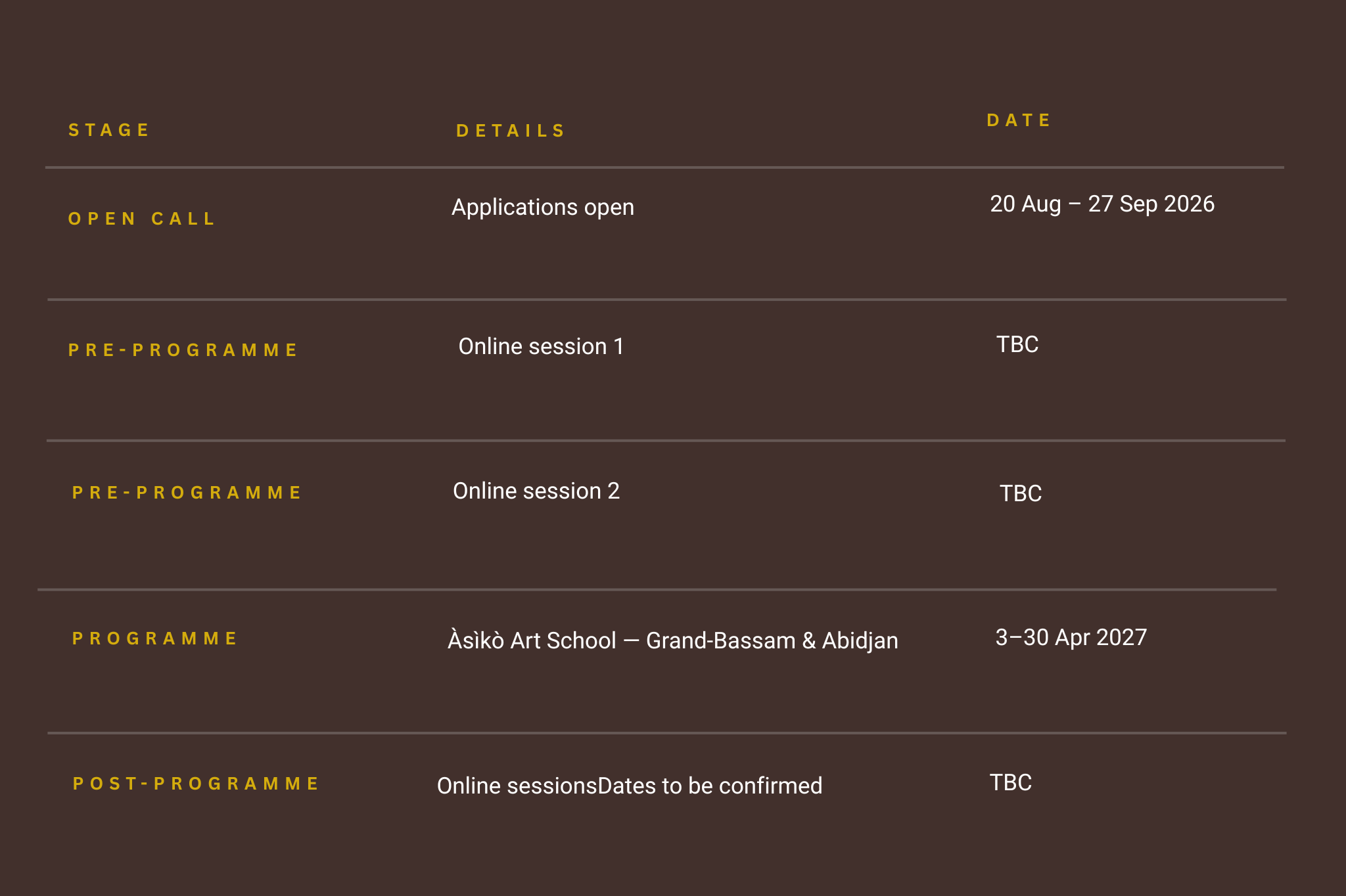
Programme 3–30 April 2027
Open call closes 27 September 2026
What happens when the tools for artistic inquiry are not imported frameworks, but the living traditions, skills and knowledge systems of the place itself?
Grand Bassam and Abidjan offer an extraordinary context in which to explore these questions. A UNESCO World Heritage town whose traditions of wood carving, weaving and textile production have sustained communities across generations sits alongside one of West Africa’s most dynamic cities, where questions of cultural economy, entrepreneurship and creative production are lived every day. Together they provide a living laboratory for investigating how value is created, circulated and sustained.
Àsìkò 2026 invites a Pan-African cohort of artists and curators to engage this context through two interlocking propositions. The first is that art can respond to economic challenges not only through commentary but through the creation of alternative models of value. The second is that local arts and craft traditions are not simply the backdrop for this inquiry; they are among its most important teachers. The knowledge held in the hands of Grand Bassam’s makers—the intelligence of materials, the ethics of care, the rhythms of slow production and the relationships between maker, community and place—forms the curriculum.
— Programme thesis
How can artists create value without reproducing the extractive economies in which they work?
This is the question at the heart of Àsìkò 2026.
Global cocoa producer
Weeks in residence
Cities — Grand Bassam & Abidjan
Four strands, woven together
Craft
Fashion & Textile
Design
Art
Structure
Knowledge moves in multiple directions. No single voice dominates.
FR+EN
French primary, English support
4 weeks
5 days/wk
Workshop benefits
Access to experienced African & international artists, curators and researchers
Who can apply
Ceramics
Performance art
Artists must be professionally active for at least three years; curators and writers, at least two.
Key Dates
Programme
costs
Non-resident participants
$800
resident participants
$400
Ásíkó Art School is made possible by Teiger Foundation
Ready to make the case for making?
FAQs
Can an early-career artist or curator apply?
Do I need an art degree to apply?
Can a diaspora artist who has never lived in Africa apply?
When do I pay the participation fee?
Do fees include logistics?
When should I apply for funding?
Apply for travel funding whether or not your participation has been confirmed yet, to avoid missing external deadlines.
Do I need to be in Côte d'Ivoire for the entire programme?
Do I need to list my references?
Funding for Àsìkó Art School 2027.
Participants are encouraged to seek funding from organisations, cultural institutions, mobility programmes, and other sources in their home countries or internationally to support the costs associated with participating in Àsìkó Art School 2027, including programme fees, travel, and living expenses. Applicants are encouraged to explore funding opportunities available to artists and cultural practitioners in their respective regions, including travel and mobility grants, cultural institutes, and international arts organisations.
As funding opportunities have different eligibility criteria and application deadlines, participants are advised to begin their fundraising and funding applications as early as possible. Importantly, we encourage applicants to apply for relevant funding opportunities even before their participation in Àsìkó Art School 2027 is confirmed, where permitted, to meet external funding deadlines. Selection for Àsìkó Art School does not guarantee funding from any of the organisations or resources identified, and participants are responsible for confirming their own eligibility and application requirements.
Several possible resources for funding for African applicants are as follows:
French mobility fund:
https://www.francophonie.org/soutien-la-mobilite-des-artistes-et-circulation-des-biens-culturels-8
385
Artists Contacts Funding
https://www.ifa.de/en/funding/artists-contacts/
Art Moves Africa (AMA)
The African Arts Trust (TAAT)- eligible to participants from East Africa
http://www.theafricanartstrust.org/
Africa No Filter
https://africanofilter.org/home
Création Africa
https://www.creationafrica.com
Prince Claus Fund
University and institutional mobility funds
Participants affiliated with universities, museums, galleries, cultural organisations or research
institutions are advised to also explore institutional travel and professional development grants.