
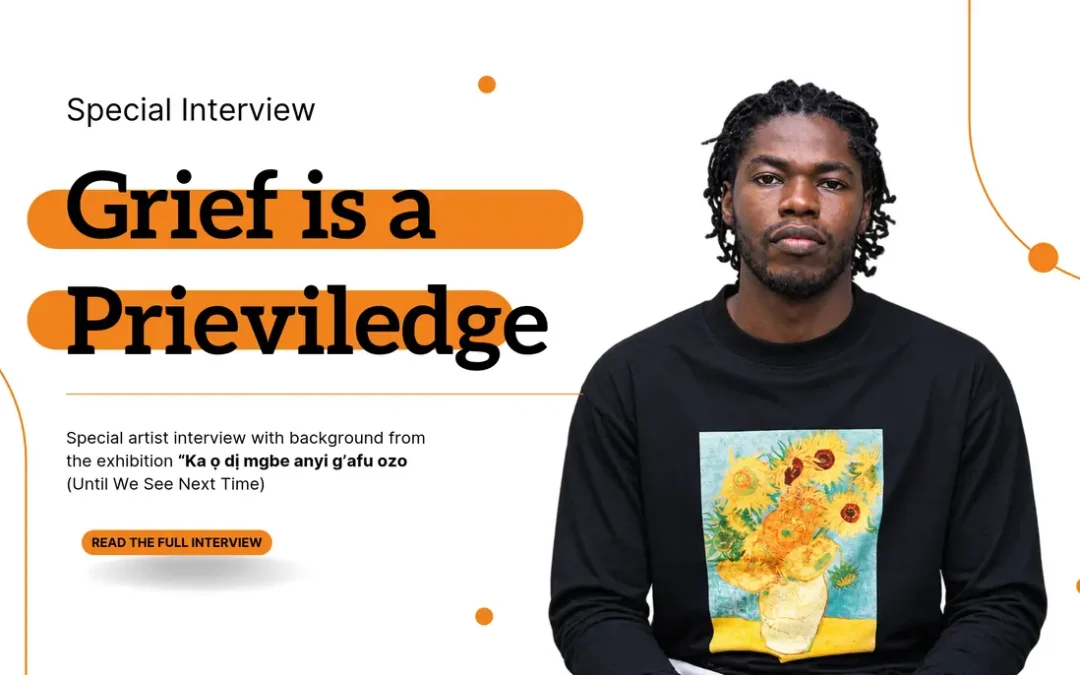
The statement, “Grief is love that has nowhere to go” best embodies poet and visual artist Ofem Ubi’s current perspective on grief. For Ofem Ubi, grief is a privilege because only the living can grieve the loss of a loved one. Here, Ofem Ubi and Izehi Amadasu discuss the inexhaustibility of memory, the sensory nature of grief, and the hope of reunion.
Izehi Amadasu: Memory sits at the center of so much of your work. What first made you realize that memory was something worth returning to again and again?
Ofem: I’d like to start by saying that memory is something that we all share and we would always pull from, like an infinite resource. Even the making of memory is memory in itself. I always say that if we all became storytellers, we wouldn’t even live long enough to tell our own stories because even the telling of a story is a making of a story in itself, which then becomes memory.
I’ve always been interested in memory because I’ve always wanted to understand who I am, to understand the people who came before me and the ones who are here as well.
Izehi: You have explored grief in earlier projects like The Last Time I Called, and now you are part of an exhibition that continues that conversation. Has your relationship with grief changed since you first began making work about it?
Ofem: Yes, my relationship with grief has changed, and it is something that keeps changing as I move through life. I used to think of grief as something very cruel, but now, I am currently in a place where I look at grief and loss as a privilege. This perspective is largely inspired by quotes I’ve heard from people.
One of them says, “Grief is love that has nowhere to go.” Another person says he hopes that his grief stays with him because it is an expression of all of the love that he was yet to give the person who they lost.
I think of grief as a privilege because it means that you’re still able to feel. You still have what it takes to be human. You come to understand that people come and that people go and that even you yourself, the artist, you’re here now, but you would also go at the end of the day. And with that understanding, you know that for the time that you’re here, for which you don’t even know how long it is, you need to make the moment count. So essentially, it makes you understand that life is a gift.
Izehi: For your work in this exhibition, you invite people to process grief through a questionnaire. Why did you choose a questionnaire—a format usually associated with bureaucracy, research, or assessment—as the form through which people encounter grief?
Ofem: Through the course of my work, I’ve moved from personal projects to having to research and explore collective memory. The idea of the questionnaire was born from my desire to bring people in and have them explore and even co-create the work with me. I’ve always been looking at how communities can make work with artists.
The questionnaire is a part of a book which is titled The Last Time I Called, The First Time I Heard. The questionnaire has two parts: the first part is addressed to the audience and the second part is questions for my grandmother.
Up until now, we had never shown the first part anywhere else, so it was important that we brought that physically into the space and have the audience add to this growing collection of what they think grief is.
“When I think of the people who have died, I sometimes think that they went in place of me and maybe that can be a very huge burden to bear.”
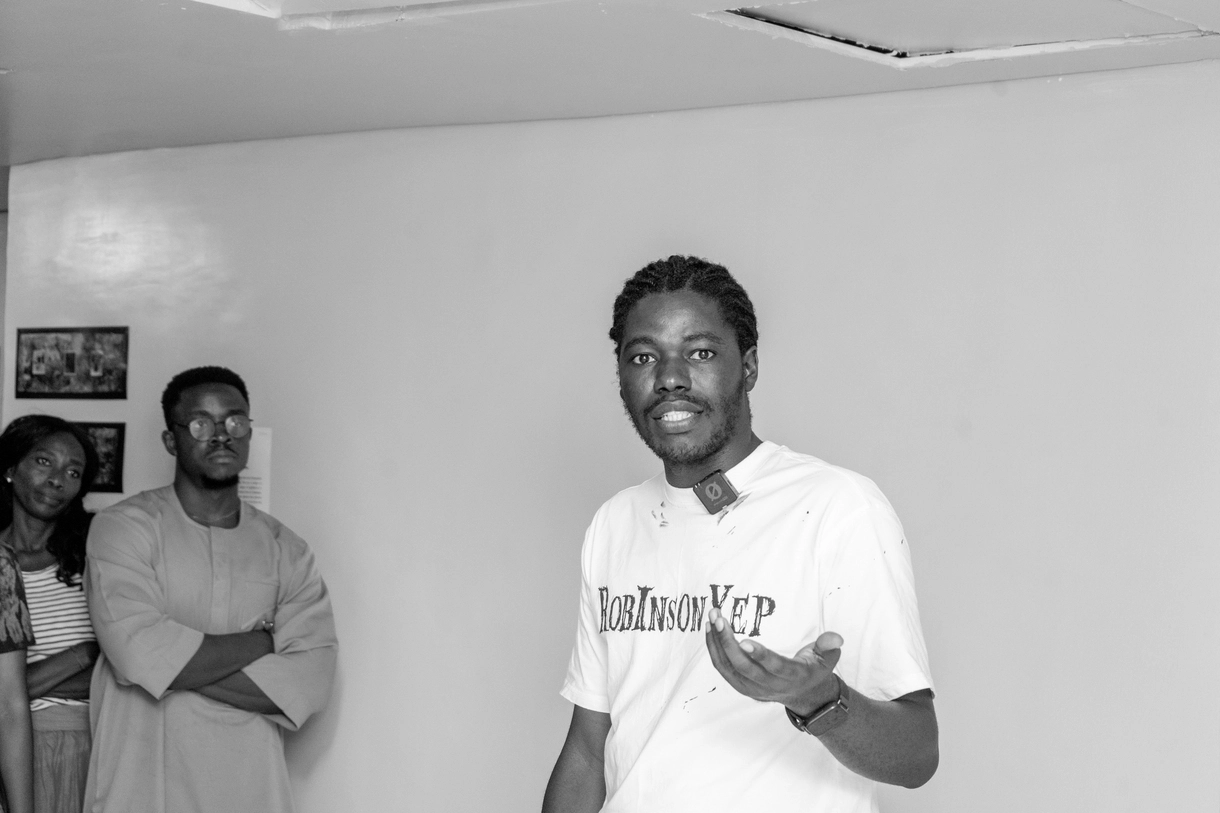
Izehi: Your questionnaire asks people to think about grief through sight, sound, taste, and touch, and even asks them to identify its smell. Why was it important for you to incorporate these sensory experiences in the conversation about grief?
Ofem: I think when you incorporate things that have to do with the senses, it helps people dig in deeper because now it’s a bit more personal. Sensory senses and sensory mappings are always peculiar to people. You might have lost a person who used a particular kind of perfume and maybe one day you just walked past somebody else and that whiff just went by and then it brings back that feeling of loss all together.
I remember back then in school, I would always see parents who would come to their children’s graduations, and because I lost my parents at six, the sight of that triggered me every single time. And it’s crazy because I’m happy for them but then I look back to myself like, well, I want that, but then I can’t have it. So simple things as such that are not meant to trigger you will trigger you and it’s just the human condition.
Izehi: If grief had a smell, what do you think yours would smell like?
Ofem: The smell that instantly reminds me of loss is the very hard odour that comes from hospital hallways. It’s very pungent to me. I remember visiting my mom in the hospital when I was very young, and every time I have to visit the hospital, I just think of that. I look at hospital beds and it just brings that memory back to me.
The second would be my grandmother’s wrapper. I still have one that I use every single day. Her smell has probably washed off because I’ve used it for a while, but every time I have that wrapper over me, I think of my grandma.
Izehi Amadasu: If someone wanted to understand you through just one poem, one photograph, one film, what would you choose?
Ofem: I would say the poem Survivors Guilt or Anikulapo by Caleb Femi. The poem makes me understand the fragility of life and the privilege that it is to be here.
When I think of the people who have died, I sometimes think that they went in place of me and maybe that can be a very huge burden to bear. But I think about it and I ask myself, if you’ve lost three to four people and you’re still here, then there’s probably something you’re meant to do, and it’s time to start doing it.
Izehi: The title of this exhibition is Ka ọ dị mgbe anyi g’afu ozo (Until We See Next Time). What does “Until we see next time” mean to you—not just as the title of an exhibition, but as a way of thinking about grief, memory, and hope?
Ofem: If you look at African cosmology, people’s lives don’t end when they die. They only depart the physical realm and they continue to exist in a realm that we’re just not eligible to exist in yet because we’re not dead. And so when I think of the title Until We See Next Time, I interpret it as “Until I transcend into an ancestor and I meet you where you are.”
It’s similar for Christians; we understand that when we die, we go to heaven and have a great reunion.
So “Until We See Next Time” anchors me with the belief for a greater reunion at the end of the day, wherever that may be.
Artists responses have been edited for clarity and concision
Ofem Ubi is a Nigerian poet and visual artist whose interdisciplinary practice explores memory, grief, nostalgia, and collective remembrance. Blending poetry, film, installation, and visual art, he examines how personal and shared histories can exist beyond the written word. His notable projects include the last time I called, Back on home soil, Sweet Potato, Family Tree, and Collage.
Through these works, Ofem continues to create thoughtful, immersive experiences that preserve memory and invite audiences to reflect on the connections between the past and the present.
Izehi Amadasu is a writer and multidisciplinary artist based in Lagos, Nigeria. Her work is centered on exploring how identities such as sexuality, gender, race, and ethnicity interweave into the human experience. Her work has been published in national and international publications, including The Republic, Face2Face Africa, Isele and Frivolous Comma.