
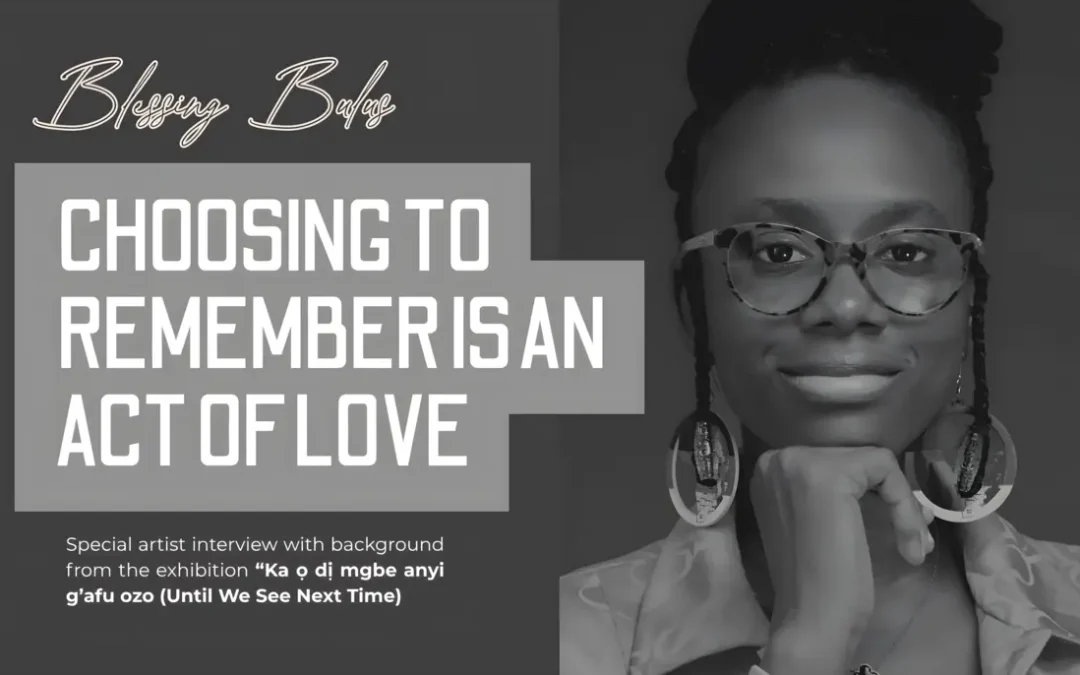
Grief is often something we want to forget because it reminds us of loss, of absence, and a future that would never materialize, but not for artist and filmmaker Blessing Bulus, whose work on grief focuses on remembering and holding on. In this discussion, writer Izehi Amadasu sits with artist Blessing Bulus to discuss grief through her lens and art, and why choosing to remember is ultimately an act of love.
Izehi: Grief is at the heart of this exhibition, and artists often find that making the work changes the way they think about its subject. Has your understanding of grief changed through the process of creating this body of work?
Blessing: It is almost difficult for me to isolate the process of making this body of work from the journey I have had over the last fifteen years. My father died fifteen years ago, and while that sounds like a very long time, sometimes the loss still feels incredibly fresh.
One thing I have come to realize through creating this work is that grief is actually love. It is love that still exists but can no longer be shared in the way it once was. So you hold on to the memories you shared, and that love begins to transform into an array of other beautiful things like stories, objects, photographs, art, places, and sometimes even a desire to understand where that person came from. I think that is what Mi Tazi has helped me understand: that grief does not necessarily disappear; it changes form.
Izehi: “Mi Tazi” means “I Remember” in Ham. Why was remembering the word you chose to anchor this body of work, especially since grief is something we often want to forget?
Blessing: When I think about my father, so much of what I see and do exists in a state of remembrance. Some of the last moments I shared with my father involved him giving my siblings and me information, some of which he asked me to write down.
There is something about that memory that stays with me because, over time, I realised I was beginning to forget what we both looked like standing side by side. That frightened me, so remembrance became something I wanted to hold onto: how he loved my siblings and me, the memories we shared, how he made me feel, the things he taught us, and even the small, ordinary moments that I did not realise would one day become precious.
“I grew up seeing and using pottery in the family compound whenever we visited the village…, but I never knew that I came from a lineage of potters or artists.”
Izehi: You returned to Nok, your ancestral home, as part of this project. What did returning to that place reveal to you about your father, your family, or yourself that you couldn’t have discovered from memory alone?
Returning home was far more of a blessing than I anticipated. There is no way I could have orchestrated the events that happened in the way they unfolded if I had tried to plan them. I grew up seeing and using pottery in the family compound whenever we visited the village for Christmas or special occasions, but I never knew that I came from a lineage of potters or artists. On the last day of our stay in the village, I got talking to one of my uncles and he mentioned that more than a decade earlier, he and some of my other uncles had accidentally excavated artefacts while working on their farm. That moment changed everything. We delayed our journey to Kaduna just to go and see what he was talking about. And there, I discovered that the pot in our family compound had actually been made by my paternal great-grandmother more than a hundred years ago. It felt like a full-circle moment for me.
During my early days studying ceramics at the University of Lagos, my course mates and lecturer would often ask if I had been sculpting before gaining admission. I hadn’t. So discovering in 2025 that my great-grandmother was an artist made me realise that what I had thought was simply a random desire to create or become an artist might actually be something deeper.
Izehi: You once mentioned you created a sculptural bust of your father, someone whose physical presence you can no longer experience. What was it like to recreate his physical form with your own hands?
Blessing: Every time I work with clay, there is a feeling I have when a shapeless form begins to take shape. I find the process incredibly therapeutic. So, initially, I thought creating my father’s bust would be business as usual, but a few days into making it, I found myself bursting into tears. Some memories I had not consciously been thinking about suddenly came alive. When my father was alive, he almost always had a shave on Saturdays. Whenever he returned from the salon, my siblings and I would touch his face and just caress him. It was such an ordinary thing at the time, but while I was working on the chin area of the sculpture, I suddenly remembered that feeling. My hands were working on the clay, but my mind was somewhere else, and for that moment, I felt a huge sense of his presence with me. That experience is something I won’t forget in a hurry.
“Every time I work with clay, there is a feeling I have when a shapeless form begins to take shape. I find the process incredibly therapeutic.”
Izehi: Making art can be deeply intuitive. We’ve seen rough sketches displayed in museums alongside paintings that took years to complete. For you, at what point do you know a work is finished?
Blessing: Personally, I don’t think any work of art is ever truly finished. If it were, perhaps there would be a point where an artist could say, “This is complete,” and never have another thought about it. But I do believe there is an intuitive point in the process when, in your mind and in your soul, you simply feel it. There is an assurance that says, yes, I have arrived at the point I need to arrive at, and that point is usually influenced by the intention or agenda you have for the work. For example, there is a text piece I was working on for this exhibition that did not make it into the final presentation, not because it wasn’t good enough, but because I felt the words weren’t quite there yet. I knew I had not arrived at the place I wanted them to be. So I left it out, but it is something I will continue to work on as I move through life.
Izehi: After spending so much time creating art that explores grief, what has been bringing you joy lately?
Blessing: Joy, to me, is not just something you wait for to come. I think you have to seek it and pursue it. For me, joy has been in very ordinary things, speaking with my mother every other day, honouring my daily spiritual devotion, chatting and spending time with people I love, seeing the colour yellow, watching short documentary series, and experimenting with Nigerian traditional textile design.
Izehi: Oh that’s wonderful! The title of this exhibition is Ka ọ dị mgbe anyi g’afu ozo (Until We See Next Time). What does “Until we see next time” mean to you—not just as the title of an exhibition, but as a way of thinking about grief, memory, and hope?
As someone who believes in the Bible and identifies as a Christian, I see the statement as an assurance that separation is not necessarily the end. There is still pain in saying goodbye, with living with their absence, and there are people I would give anything to speak to again, to touch again, to hear their voices again, but “until we see next time” gives me a language for that absence that is different from simply saying goodbye. It allows me to hold grief and hope at the same time. While it hurts that the goodbye is now, I believe there is hope for reunion someday, and I would say that is what remembering does for me. It keeps a relationship alive in a different form. My father is no longer physically here, but the love, memories, lessons, stories, and traces he left behind continue to shape who I am.
Artists responses have been edited for clarity and concision
Blessing Bulus is a multidisciplinary visual storyteller, director, creative producer, and co-founder of Azure Studios. Her work spans documentary film, television, and visual media, exploring identity, memory, heritage, and collective history. A graduate of the MultiChoice Talent Factory and a 2025 Documentary Film Fellow with the French Embassy in Nigeria and StoryMi Academy, she combines research-driven storytelling with creative production. Her notable works include Mi Tazi, Iwa Ji, and Under the Influence (Showmax), all reflecting her commitment to connecting people with culture, history, and lived experiences.
Izehi Amadasu is a writer and multidisciplinary artist based in Lagos, Nigeria. Her work is centered on exploring how identities such as sexuality, gender, race, and ethnicity interweave into the human experience. Her work has been published in national and international publications, including The Republic, Face2Face Africa, Isele and Frivolous Comma.