
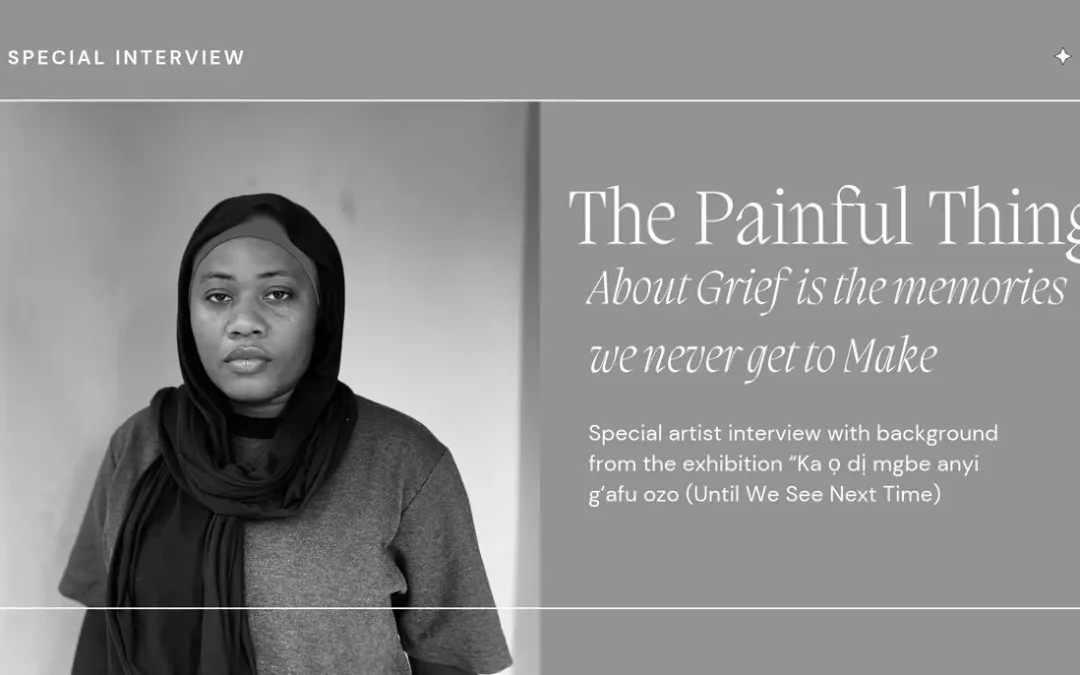
Visual artist Ololade Lawal experiences grief through a detached lens. For her, grief isn’t fueled by the memories we hold of loved ones we have lost but by the memories we never got to make. For Ka ọ dị mgbe anyi g’afu ozo (Until We See Next Time), Izehi Amadasu speaks with Ololade Lawal about grieving without memory, the meaning of home and how spaces evolve to hold our grief.
Izehi: Your work often looks at family structures, domestic histories, and the way people adapt to life in modern Lagos. What first drew you to these everyday spaces and stories?
Ololade: My interest in everyday spaces and stories is grounded in my own personal history. I grew up in a polygamous household, which as we all know, comes with its own menace.
That experience of growing up in a shared space and doing everything with certain people made me curious about the family systems that persist in modern-day Lagos. For instance, are people still thinking about polygamous families the way they were thought about 40 or 50 years ago? If not, how are they thinking about them now? How does the current time influence how these family structures are being experienced?
Izehi: Speaking of family, home can hold some of our happiest memories, but it can also hold loss, conflict and things we don’t talk about. So what does the idea of home mean to you?
Ololade: This particular question is something that I am still actively finding answers to through my work, the spaces I inhabit and my perception of things. I’ve come to understand that the idea of home is not absolute. For me, home evolves with the kind of person I’m trying to become.
From the perspective of home being about connection, I would say I’m still finding home. But in a more physical sense, I do have spaces that I call home and I also have people who make those spaces even more homely for me.
Izehi: We often think of grief as something that happens when we leave a place or lose a person, but sometimes the spaces around us can carry their grief too. So how do you think our homes hold memories of the people and experiences we have lost?
Ololade: Like I earlier mentioned, home isn’t a concrete place for me. And given my upbringing in a polygamous home where I lost both parents at an early age, I feel a sense of detachment from the house I grew up in. Some of the people who lived there 10-20 years ago have either relocated or travelled, so when you enter the space, you get a sense of absence.
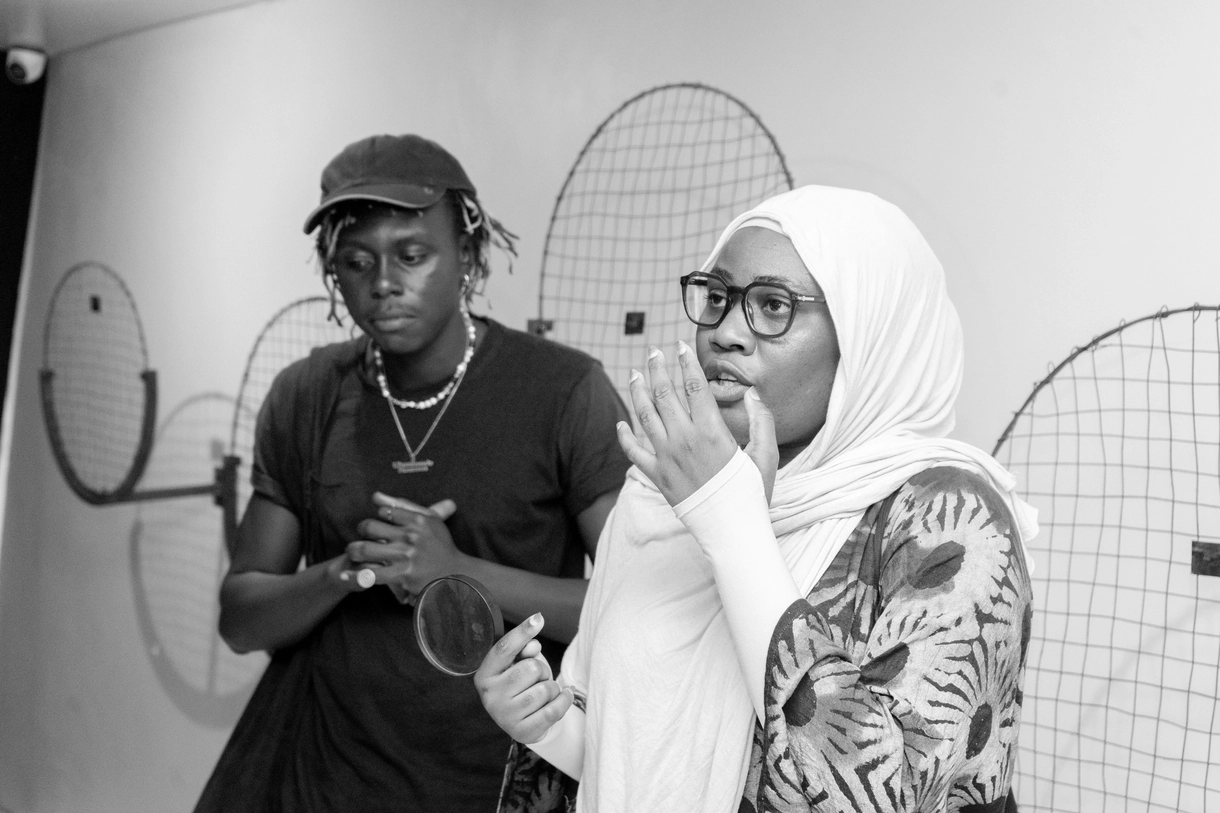
Although the space has evolved in some ways, it’s still very stagnant in some other ways, and that in itself is grief. My father was the one who held the family and space together, but in the aftermath of his demise, spaces like the living room, where family members are supposed to commune, became partitioned and separated. There’s this idea of “this is your part of the house and this is mine, and you have no business coming to mine.”
So this separating and partitioning of the house is a reflection of the loss that took place and the resulting grief.
“I think there’s an aspect of my work that is niched for people like me who do not necessarily have memories of people they wished they had memories of.”
Izehi: What particular experience or realization made you want to explore grief in your work now?
Ololade: That realization came when I lost my paternal grandmother in 2021. Although I lost my mum when I was five and my father two years later, I couldn’t really understand how significant that was because I was little. The loss of my paternal grandmother, on the other hand, happened in adulthood, when I was able to see grief in its raw form.
So after her death, I had this curiosity to discover who my parents actually were as individuals. I became interested in creating conceptual images of them. But those images felt quite incomplete; you can literally sense the limitation of my memories and those of others who actually knew them.
The artworks you see in the exhibition are my attempt to reenact their identities through what I believe still exists, particularly parts of them that my siblings and I inherited.
Izehi: What emotions or conversations do you hope visitors leave with after they encounter your work in the exhibition?
Ololade: I think there’s an aspect of my work that is niched for people like me who do not necessarily have memories of people they wished they had memories of. My work really is asking: how can you create memories from a lack of them? What are the more personal ways to grieve somebody?
As opposed to telling visitors what grief is or how to grieve, my art is more focused on helping people identify the existence of grief deep within themselves and how they can express themselves through it.
I understand that people grieve in different ways. For me, though, I experience grief through a very detached lens, so I wanted to see how my detached view of grief can be a point for collective grief. The photographs in the exhibition are body parts of my siblings and me. So it’s not only my own personal grief I’m expressing but the collective grief of my siblings and me.
Izehi: We’ve been talking a lot about grief, so on a more lighthearted note, if we followed you around Lagos for a day, what is something you think we’ll notice about you that we won’t expect before?
Ololade: Probably that I love Crocs! I’m probably addicted to them at this point. I just love how comfortable they are. But aside from that, I’m also very interested in architecture, in how buildings are built and how they shape social dynamics.
Also, if it’s a day Arsenal is playing, you’ll definitely find me somewhere watching the match. They are my favorite team in the world.
Izehi: The title of this exhibition is Ka ọ dị mgbe anyi g’afu ozo (Until We See Next Time). What does “Until we see next time” mean to you—not just as the title of an exhibition, but as a way of thinking about grief, memory, and hope?
Ololade: One thing I know is that African languages are usually so metaphorical and heavy with meaning that the English translation can’t accommodate. So I’m going to translate “Until we see next time” to Yoruba. It says Ojú wa yóò tún pàdé, which literally translates to “our eyes will lock again.”
It alludes to some kind of memory that I don’t have and I’m still trying to recreate through my art. So honestly, I really do not know what it is right now that I would want to see next time.
But within the context of my faith, there’s a space for the afterlife, there’s a space for reuniting. So it creates this idea that all of the memories I am trying to reconnect with, there’s an archive of them in the afterlife. But then the idea of reuniting makes you wonder what your reaction is when you see them. Are you all smiling, sad, or do you have questions? So it feels like there are all of these layers that need to be unearthed.
Artists responses have been edited for clarity and concision
Based in Lagos-Nigeria, Ololade Lawal is a visual artist working across abstract painting, photography, installation, artistic research and new media. Her works address themes of family structures, domestic histories, and the influence, adaptation of living systems in modern Lagos. Lawal has a diploma in Mass Communication from Yaba College of Technology. She has shown in group exhibitions and Art fairs in Nigeria and abroad, with her first solo show in 2023 and featured in Ake Review that same year. She is a G.A.S Foundation Imora fellow and Kuta Arts Residency Alumna
Izehi Amadasu is a writer and multidisciplinary artist based in Lagos, Nigeria. Her work is centered on exploring how identities such as sexuality, gender, race, and ethnicity interweave into the human experience. Her work has been published in national and international publications, including The Republic, Face2Face Africa, Isele and Frivolous Comma.